

You probably know the feeling: your eyes burn. Your brain feels like mush, and yet you’re still scrolling. The typical adult now spends close to 7 hours a day staring at a screen, and that number has only climbed since 2020.
Read that again if you need to. Wait; there's more to it.
What used to be a convenience is now a compulsion. It’s silently wrecking sleep, focus, and mood.
Specifically a digital detox and practical steps, to be more precise, to reduce screen time have NEVER been more fitting.
TL; DR
- Even a partial digital detox can improve mental health, sleep, and attention—you don’t need to quit your phone entirely to feel the difference.
- Committing to just two weeks of intentional screen reduction can break the worst habits and reset your relationship with technology.
- The hardest part is the first few days: boredom and the itch to check notifications are normal, but the payoff in calmer evenings and sharper thinking is worth it.
Key Point
- Reducing screen time isn’t about going off-grid forever—it’s about reclaiming the hours where technology has edged out real life. Even small, consistent changes can shift your mood and mental clarity noticeably.
- Most people try to cut back by deleting apps, but that rarely sticks if you don’t replace the habit with something concrete. A better plan targets the triggers, not just the screens.
- The research is clear: a 2025 study in Frontiers found that intentional disconnection improves cognitive repair, emotional control, and offline satisfaction. You’re not just scrolling less; you’re training your brain to handle stress differently.
What Is a Digital Detox?
A digital detox means purposefully reducing screen time to break the cycle of constant connectivity, without necessarily abandoning your devices. As it turns out, it can look like phone-free meals, a tech-free Sunday. Or simply keeping your phone out of the bedroom. More regularly than not, it’s to interrupt the automatic checking habit that drains attention and cranks up stress.
Is it really possible to unplug in a hyperconnected world?
Setting that to the side, yes, but it’s less about unplugging completely and more about drawing boundaries that make tech serve you, not the other way around. People who succeed don’t go full hermit. In the bedroom, and build from there.
They start with one exact rule, like no screens. That small shift regularly creates a cascade of better sleep (as one might expect) and calmer mornings.
Which makes the rest of the detox easier to stick with.
Why a Digital Detox Matters for Your Brain and Body
Taking a step back reveals an important factor. Hundreds of tiny interruptions, pings, vibrations, badge icons, keep your brain in a low-grade fight-or-flight state all day, and honestly, when you intentionally cut back, that background noise drops, and your focus and mood begin (which aligns with standard practices) to recover within days.
“Digital detox offers cognitive and emotional advantages, like improved attention, stress reduction, and improved self-reflection.” — Frontiers in Human Dynamics, 2025
From a broader view, which is to say, this isn’t about willpower (depending entirely on the context) or moral failing. It’s about human neurobiology. Your brain simply wasn’t built to process the firehose of information that modern screens deliver, and it pays the price in fragmented attention and emotional exhaustion. A detox gives your mind the quiet it calls for to repair.
How does less screen time actually lower stress?
Constant notifications force your brain to context-switch dozens of times an hour. Each switch burns glucose and elevates cortisol. Leaving you feeling frazzled even if you didn’t accomplish much.
When you silence those pings and create screen-free blocks. Your stress hormones have a chance to reset.
People all the time report a noticeable drop in anxiety within the first three days of reduced screen time.
What are the most common pitfalls people face?
For the average user, honestly, the biggest trap is substitution, not screen time itself. Georgetown University researchers flagged that reducing one app often just shifts the time to another screen activity. Like YouTube or streaming.
So you feel like you’re cutting back, but the mental clutter (at least based on current observations) stays the same. That’s why a real detox asks for to fill the gap with something non-digital, a walk. A book, actual face-to-face conversation.
And here’s something most articles skip: the first 48 hours can feel miserable. Boredom; anxiety, and a compulsive need to check your phone aren’t signs you’re doing it wrong, they’re proof the detox is working. After about two weeks, that reflexive grab for the phone fades, and your baseline level of calm shifts upward.
A Practical Action Plan to Reduce Screen Time
” Concrete, measurable changes stick due to the fact that they give your brain a clear rule to follow.
“Commit to at least two weeks.” — Cleveland Clinic Health Essentials
Keep in mind what we talked about earlier, consider this practical perspective. Two weeks is the minimum window for breaking a behavioral pattern. After that, the new normal starts to feel automatic.
“Charging your phone outside of your bedroom and setting timers for specific apps are effective ways to start.” — Georgetown University
The plan isn’t complicated. You just need to pick one rule. And defend it like your sanity depends on it, because it kind of does.
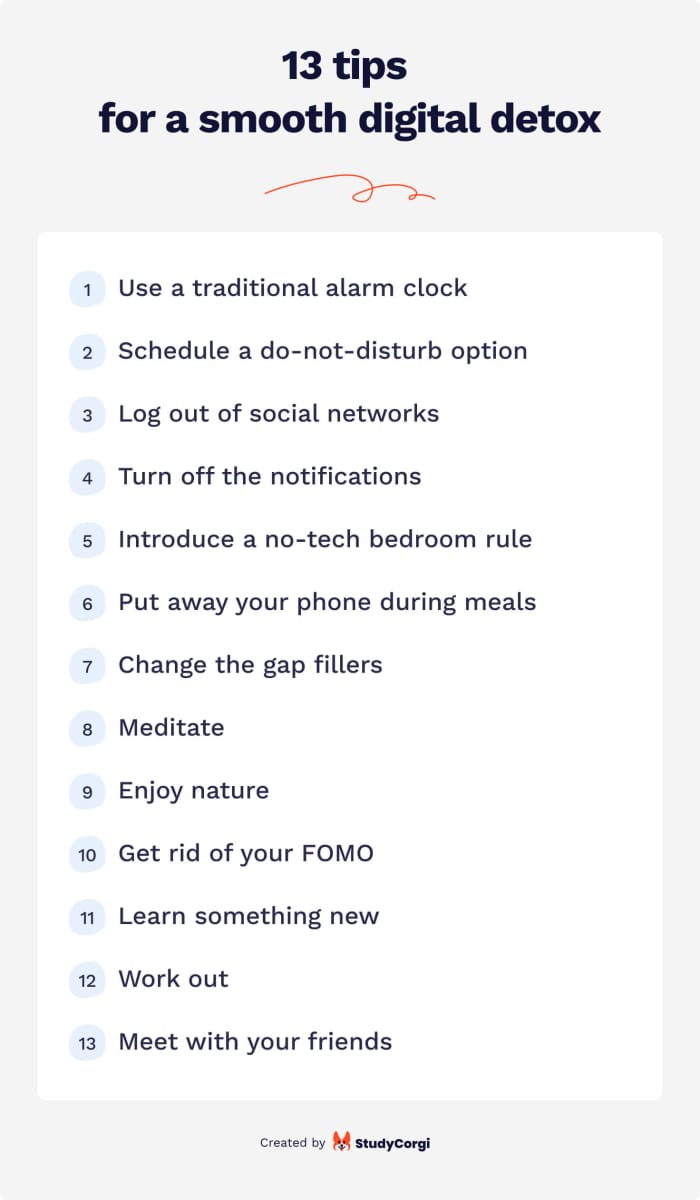
- Declare a phone-free zone — Start with the bedroom. Charge your phone outside the room tonight and use a basic alarm clock instead. This alone often improves sleep within a week.
- Silence non-essential notifications — Go into your settings and turn off everything except calls from favorites. The drop in interruption is immediate and surprisingly calming.
- Set a two-week timer — Commit to one specific screen rule (like no phone after 9 PM) for exactly 14 days. Mark the calendar; treat it like a challenge you can win.
- Replace the scroll with a real activity — Keep a list of offline alternatives where you usually sit and scroll. A five-minute stretch, a quick chore, or even staring out the window beats another dozen reels.
- Track urges, not minutes — Instead of obsessing over screen time stats, jot down each strong urge to check your phone and what you were feeling. Patterns emerge fast, and awareness is half the battle.
- Review and adjust after two weeks — At the end of the commitment, evaluate what worked. If bedtime without a phone stuck, lock it in permanently and pick a second rule to tackle next.
What’s the single most effective first step?
Turn off every notification that isn’t from an actual human you care about. No breaking news, no app alerts.
No email badges, and honestly, that one change removes the triggers that keep pulling you back, so your brain stops expecting a dopamine hit every few minutes. Most people are shocked at how much calmer they feel within 48 hours. File that away. You'll see why it matters in a bit.
People Also Ask
How long does it take to feel the benefits of a digital detox?
The underlying point remains direct. You’ll likely notice a difference within three to five days. Most likely the deeper cognitive repair, like sustained attention and sharper self-reflection, usually kicks in (which works out well in practice) after the two-week mark.
Can a partial detox where I only cut one app work?
Yes, and for a lot of people that’s the most lasting path. Reducing even a single problematic platform can improve mental health and sleep quality, especially. If you use the reclaimed time for offline activities instead of hopping to another app.
What if I fail after a few days?
This brings up an interesting angle. It’s not failure, it’s data. The first tried reveals your strongest triggers, and most the majority need two. For the most part, next round, tweak the rule a bit to make it easier, and remember the two-week commitment isn’t a prison sentence; it’s a trial run.
Is screen time right before bed that harmful?
Yes, partly due to the fact that the blue light suppresses melatonin, but mainly. Because the content itself keeps your mind, or at least, racing when it should be winding down. Within a few nights, charging your phone outside the bedroom removes the temptation and dramatically improves sleep latency.
Are there any tools that actually help with a digital detox?
Taking a step back reveals an important factor. Under normal conditions, built-in screen time trackers on iOS. And Android, plus apps like Freedom or StayFocusd, can gave guardrails. The Georgetown University research stresses that the real benefit comes from pairing resources with physical separation—like an out-of-sight charging station—rather than relying on software alone.
FAQs
Will I miss out on important updates if I turn off notifications?
It’s a common fear, but an unfounded one for most the majority. True emergencies rarely arrive via push notification. You can set VIP call alerts or scheduled check-in times to stay reachable without living in reaction mode.
Do I need to quit social media entirely?
Not at all. Many those using it find that scheduling 15-minute windows twice a day, actually, hold on, for social apps gives them the connection they want without the endless scroll. That's a significant gap. The key is deliberate use, not passive consumption.
What if my job requires constant screen use?
Then your detox shifts to personal screen time. The goal isn’t zero screens; it’s zero unnecessary screens, which is why enforce tech-free meals, protect your first hour after waking, and reclaim evenings by dumping recreational scrolling. So even in screen-heavy jobs, those boundaries create measurable improvements in mood and focus. Yet, context matters heavily.
Is there any downside to digital detoxing?
Circling back for a moment, in the first few days, yes—boredom. Mild anxiety, and a nagging fear of missing out. Those feelings are withdrawal symptoms from constant stimulation. Yet, not evidence that the detox is bad for you.
Within a week, most the majority report a greater sense of control and more authentic enjoyment of quiet moments.
Final result: Truly a digital detox. Practical steps to reduce screen time come down to treating your attention like the precious resource it's.
You don’t need a radical offline retreat. You need a handful of stubborn, well-chosen boundaries that give your brain a break. For the most part, and watch what happens when you stop letting pixels run your day.
🔍 Research Sources
Verified high-authority references used for this article
- frontiersin.org
- georgetown.edu
- health.clevelandclinic.org
- pmc.ncbi.nlm.nih.gov
- webmd.com
- brownhealth.org
- aanmc.org
- nkchealth.org