

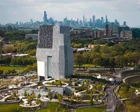
Chicago's South Side skyline looks different these days as a massive granite structure rises above the trees of Jackson Park. Now flip that around. This building isn't your normal government office or school; it is the long-awaited Obama Presidential Center.
Some critics have already labeled the design ‘Like a Klingon prison’: inside Barack Obama’s audacious. Near-windowless, $850m presidential library, highlighting the stark, windowless walls that stand 70 meters high.
The trend keeps going. While the project aims to bring hope to a low-income area, its imposing size and grey stone facade feel more like a fortress than a neighborhood hub. The real question is; does it work? This 19-acre campus is the most expensive and boldest effort; yet to cement a former president's legacy in stone and digital code.
Key Point
- The center spans 19 acres and costs roughly $850 million, making it the most expensive presidential library ever built.
- Obama personally influenced the angular design, moving away from traditional styles to create something he calls "iconic."
- Unlike previous versions, this site will not hold physical paper records. Instead, it serves as a digital-only archive run by a private foundation rather than the National Archives.
- Neighborhood residents remain split on the project, with some fearing rising rents while others look forward to the new NBA-spec basketball court and public garden space.
- The main tower features a "sky room" with city views, though the lack of a traditional skylight in the pyramid ceiling has baffled some early visitors.
Why locals call it ‘Like a Klingon prison’: inside Barack Obama’s audacious, near-windowless, $850m presidential library
The Obama Presidential Center is a 70-meter-high granite monolith in Chicago that houses a museum, a public library branch, and community spaces. It's known for its windowless, defensive design and $850 million price tag, focusing on a digital-only archive rather than physical historical documents.
When you stand at the base of the tower, the sheer scale of the granite walls is overwhelming. These stones erupt from the ground at sharp angles.
Creating a shape that looks like four hands coming together to protect a flame. From a distance, the lack of windows makes the building look like a defensive bunker or a high-tech prison from (as one might expect) a sci-fi movie. Architects Billie Tsien and Tod Williams admit the president was extremely involved in every corner.
Where does that leave us? Cut of the stone. He wanted something that looked like a piece of art, Actually, citing his love for the sculptor Brâncuși. However, nuance is required here.
Nine times out of ten, calling it a library is a bit of a stretch mostly since there're no physical stacks of presidential papers here. Everything is digital. This shift has upset some historians who — well — actually, believe the National Archives should manage these records. Instead, the Obama Foundation runs the show, which raises questions about how objective the history on display will be.
| Feature | Obama Presidential Center | Traditional Presidential Libraries |
|---|---|---|
| Total Cost | Approximately $850 Million | Average $150 – $300 Million |
| Archive Format | 100% Digital Records | Physical Paper and Artifacts |
| Governance | Private Obama Foundation | National Archives (NARA) |
| Key Amenity | NBA-spec Basketball Court | Research Reading Rooms |
| Main Material | Grey Granite and Bronze | Varies (Brick, Stone, Steel) |
Walking through the vertical experience in Chicago
Visitors pay $30 to enter the museum tower, which offers four floors of interactive displays about the lives of Barack and Michelle Obama. The experience includes a full-size Oval Office replica and ends in a high-altitude observation room with views of the Chicago skyline and Lake Michigan.
Inside the tower, the mood shifts from the heavy exterior to a snappy-paced (at least based on current observations) walk through history. You start with the civil rights movements that shaped the 44th president.
And move upward through his campaigns and two terms in office. It feels less like a dusty museum and more like a high-budget movie set. You'll see custom sneakers, campaign buttons, and even a replica of the Oval Office.
It's a calculated, immersive journey designed to make you feel like you can also change the world.
It's giant panoramic windows that look out over the city. Hang on – there's more. Yet, when you look up at the white pyramid ceiling.
It's just a solid plasterboard finish. This choice seems odd for a building that claims to be a case in point. Is it a metaphor for a glass ceiling that hasn't been broken yet? Or was it just a budget cut during the long construction process?
There's a branch of the Chicago Public Library where you can actually sit in a replica of Obama’s favorite reading chair. I know – it's a bit much.
There's also a shiny sports pavilion called Home Court. It features a full indoor basketball court.
Where the foundation hopes to train the next generation of leaders. These parts of the park are meant to prove that the center is for the people, not just (which works out well in practice) for the history books.
Our Final Opinion
The Obama Presidential Center is a bold bet on the future of how we remember our leaders. It moves away from the old model of dusty archives.
And moves toward a community-focused hub. While the design is controversial and expensive. It brings a massive investment to Chicago’s South Side.
- The $850 million cost is a record-breaking figure that sets a new bar for future presidents.
- Shifting to a digital-only archive is a risky move that might limit how future researchers study this era.
- The NBA-spec basketball court and public park spaces are the real wins for the local neighborhood.
- Some may still see the tower as a "Klingon prison," but others will see it as a symbol of power and progress.
Building on that earlier point, what you'll notice is whether you love the architecture or hate it, you can't ignore it. This monolith stands as a permanent part of the Chicago skyline now. It reflects a president who consistently wanted to be an architect of change. Only time will tell if this digital monument truly helps the community or just stands as a giant, granite shadow over it.
News & image source: https://www.theguardian.com/artanddesign/2024/oct/22/klingon-prison-barack-obama-presidential-library-chicago